Episode Overview
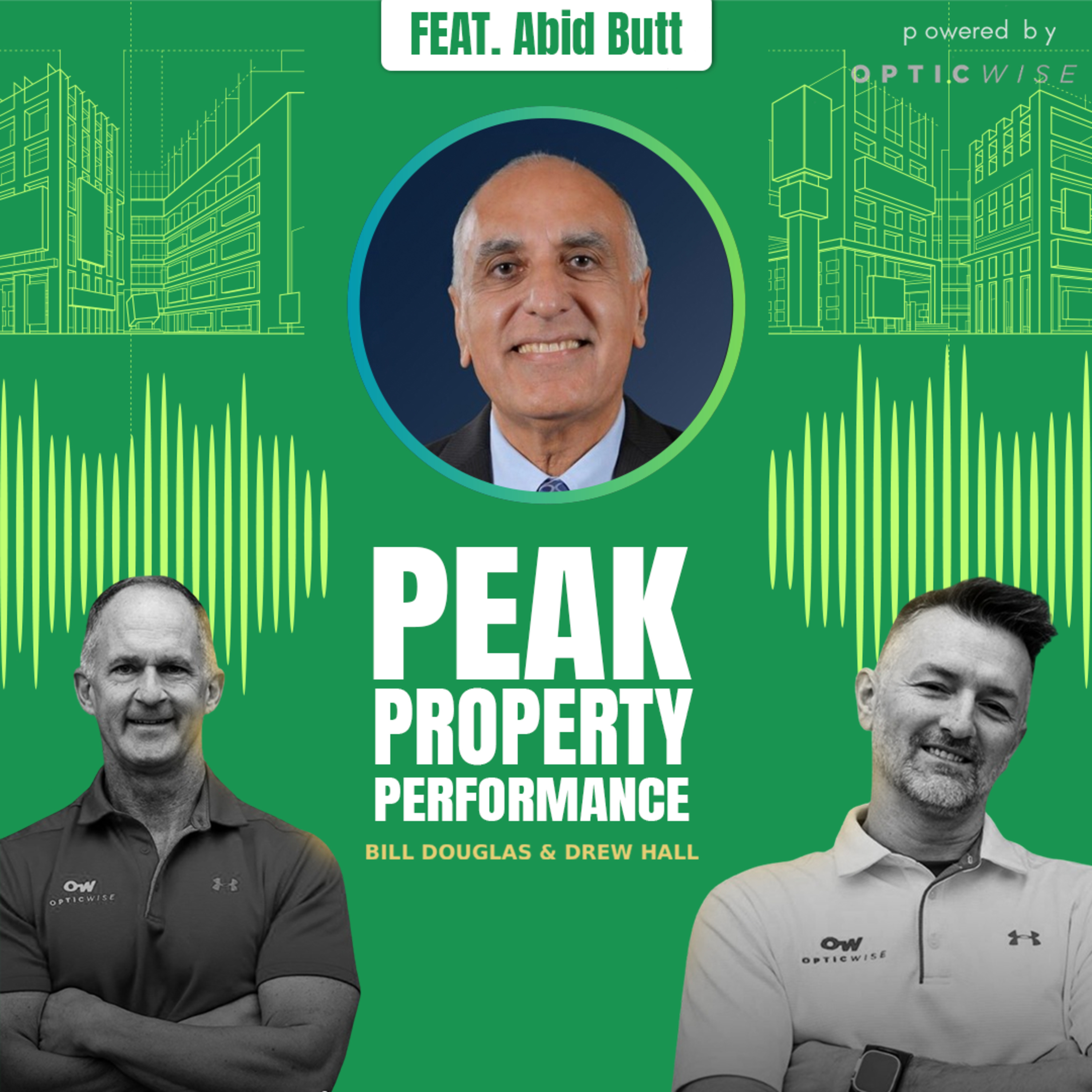
Asset managers sit in one of the most demanding seats in commercial real estate: protect performance, manage risk, allocate capital wisely, and decide which operational changes are actually worth making. In this episode, Bill Douglas and Drew Hall talk with Abid Butt, a hospitality and real estate executive who has managed a diversified portfolio worth roughly $9 billion across hotels, office towers, residential compounds, and a mega-regional mall, about what asset managers really need from data, technology, and CRE operations.
Abid explains why he treats assets as “living, breathing entities,” why risk-adjusted yield is the number that matters, and why so much technology spend fails to deliver. The throughline: connected, reliable data and predictive analytics beat backward-looking dashboards every time, but only when owners, operators, and technology teams align around a clearly defined objective.
“Assets are living, breathing entities that people give life to and then we have to nurture and care for.”
Abid Butt
What you’ll learn
- What asset managers actually evaluate, risk-adjusted yield, NOI, and EBITDA margins
- Why asset managers, operators, owners, and vendors are more aligned than they appear
- Why predictive analytics beats backward-looking dashboards and report-card metrics
- The most common reasons technology deployments fail in CRE operations
- How to think about AI spend when there is no clear objective, and what to do instead
- What actually motivates owners to change before a problem becomes a crisis
Key moments
- 00:00Intro: Drew and Bill welcome guest Abid Butt
- 03:10What asset managers evaluate when judging property performance
- 05:38Are asset managers misunderstood by owners, operators, and vendors?
- 08:13The visibility asset managers wish they had: real-time, predictive data
- 10:13Forward-looking KPIs vs. backward-looking dashboards
- 13:04Why technology purchases fail without vision, training, and support
- 17:18Golf-course irrigation: a cautionary technology story
- 19:39“Oodles of money” spent on AI with no clear objective
- 24:07Why AI shifts skill sets instead of simply replacing people
- 25:46What finally motivates owners to make a change
- 29:51Extra Floor: rapid-fire with Abid Butt
Resources mentioned
- OpticWise: https://opticwise.com
- Peak Property Performance Book
- Peak Property Performance Podcast: https://www.peakpropertyperformance.com
- Apply to be a guest: https://www.peakpropertyperformance.com/be-on-the-show/
- Book a Digital Infrastructure Review: https://www.peakpropertyperformance.com/ppp-review/
Connect With The Guest
Abid Butt
Hospitality & Real Estate Executive · Asset Management
- LinkedIn: linkedin.com/in/abidbutt
- Email: me@abid-butt.com
Connect With The Hosts
Bill Douglas (Host)
- LinkedIn: linkedin.com/in/billdouglas
- Email: bill.douglas@opticwise.com
- OpticWise: opticwise.com
Drew Hall (Co-Host)
- LinkedIn: linkedin.com/in/drewhall33
- Email: drew.hall@opticwise.com
- OpticWise: opticwise.com
Read the full transcript
Drew Hall: Welcome back to the Peak Property Performance podcast. I am your co host, Drew Hull. And before we get to all the parties involved on this go around, let me tell you about this, this theme. For this episode we're going to talk about what asset managers really need for from data technology and operator. And before we introduce our guests, a reminder as always to listeners to like subscribe, share, shout it out, what other analog ways you can think about, whatever. Don't hide your excitement about this podcast is what I'm saying. You know, it's there. This is how we're spreading the word about the peak property performance movement and honestly changing an industry for the much, much better.
Drew Hall: And if you feel like you would be a good guest or you know someone who would be a good guest here, please, please reach out to us. We welcome commercial real estate thought leaders, stages of ownership and operation. Probably the best place to find us is there at our website, peak property performance.com all of the contact information and everything about all of our episodes and things are there as well. So we look forward to hearing from you. It's not just me, of course. First, let me introduce co host Bill Douglas. Bill, welcome.
Bill Douglas: Drew, thanks for the introduction. I like how you said that too. And the website as of today even has an application page where you want to be on it. You can listen to the episodes, you can see the book, you can see the process. There's things about roles in there, but you can also apply to be on the show. So go there. Today we are joined by Avid Butt. Say hi Avid, before I read your intro.
Abid Butt: Well, thank you for having me as part of this conversation, guys.
Bill Douglas: I'm really looking forward to it.
Abid Butt: And today's episode is going to be far more exciting, as Drew has said.
Drew Hall: I like it. I like it.
Bill Douglas: Abbott is a hospitality and real estate executive whose career has crossed ownership, operations, brands, travel, tourism and asset management. Most recently, Abbott managed a diversified real estate portfolio valued at roughly $9 billion, sparing hotels, office towers, residential compounds and a mega regional mall. So he's seen a lot of, to say the least, that gives them a valuable perspective for this conversation. Because asset managers sit in a difficult seat. They have to protect performance, manage risk, understand operations, and decide which changes are actually worth making. So that's why I'm excited, because Abbott and I have talked about this before the show like we like to do with our guests. So again, Avid, welcome to the show.
Abid Butt: Thank you very much. Very glad to be here.
Drew Hall: All right, Abbott, let's, let's start here in terms of how Asset managers actually think about the performance of the property. We know that asset managers are not anti technology, but they are cautious because after all, you're paid to allocate the capital, wisely protect the performance and also manage the risk. So it's a happy balance, like so many things. But from an asset manager's seat, what are you really looking for when you evaluate whether a property is performing well?
Abid Butt: Well, at the end of the day, asset management function is all about optimizing and enhancing the asset performance. There are several different components, several different pieces of the puzzle that go into that. But that's really the essence of asset management. Now evaluating performance of an asset is more than just looking at the numbers quite candidly because there are lots of moving parts. I have said that assets are living, breathing entities that people give life to and then we have to nurture and care for. So there is lots of different things going to it. But at the end of the day we looking for a risk adjusted yield. That's what it comes right down to.
Abid Butt: One of the key elements that is applicable is NOI net operating income or EBITDA margins or EBITDA per square foot in some asset classes, per occupied room in other asset classes. That's really the essence. No, there are multiple, multiple, multiple data points that tell the story as to where we might have gotten sidetracked or what we might need to focus on. But the essence comes down to am I going to be able to meet the debt? Am I going to be able to service the debt? Is the long term objective for the asset? Is that being met or not?
Drew Hall: Ooh, I really like what you said about it being a living, living, breathing organism in a sense because I feel like, you know, life cycle is something we talk about so often because the building is, the building is the building or the campus, whatever it is the portfolio. And then, you know, all of the different players in the life of that portfolio might come and go or change hats, whatever, but the property lives on, right? And it's occupied and it continues to generate all of that data that we're talking about and the performance ultimately. So I love that we talk about that all the time. I love it. Would you say that asset managers are misunderstood from the operators or the owners or even the vendors perspective sometimes just in terms of how the, the asset managers think? Do you think that there's a misunderstanding there from all those other parties? That's material.
Abid Butt: Look, asset management is a strategic discipline, at least from my point of view, it's a strategic discipline. It depends on the asset class that is being managed and the lenses that we put on the information available to us to manage that asset. Sometimes asset managers become the bad guys because here's the guy showing up with a clipboard and he's going to walk around and tell us all the things that we're doing wrong or the information that is being looked at is being looked at in a vacuum without the complete information. So it is a new discipline, particularly in real estate sector. It's still a new discipline and a lot of people have to be educated on it. Also it is going through a massive transformation with the advent of technology. And you brought up earlier, there is lot more information available to us today than there ever was. Actually in some cases there might be an information overload so we need to dumb it down and simplify it so that it becomes in usable bite sized pieces that are actionable.
Abid Butt: But going back to your your original question, sometimes there is a perceived misalignment that asset managers don't care about anything else other than abc, whatever that ABC happens to be. I'm of the opinion that there is an absolute alignment between the asset manager and the operators and the vendors and everybody that is involved in that spectrum. I think they're all aligned as long as the goalpost is defined. Sometimes we fail to communicate and define that goalpost clearly, which leads to a bit of a fragmented approach. But that's where the misunderstandings come from. At the end of the day, the owner wants to maximize the returns, the operator wants to maximize the returns. The all stakeholders are after the success of that particular asset. No different that asset manager is doing it.
Abid Butt: As a matter of fact, asset manager becomes a bit of a bridge that connects all these different venues if you would to be focused on the ultimate delivery. But yet it does have misunderstandings. There's no doubt about that.
Bill Douglas: I see or we see, I should say Abbott. Asset managers often want better visibility. They want more reliable operating feedback, they want earlier warning signals. But the building systems teams on site vendors rarely make that easy. So my question given that setup is if you could have any data or visibility across the assets you managed, what would you have wanted that you usually didn't have?
Abid Butt: Well, you're absolutely correct. Asset managers want more information, more real time information and more so now than ever. More predictive analytics and, and that's the only way we can go from driving a bus, looking at the rear view mirror and looking forward. That has become critical now we must understand the infrastructure that real estate industry is using and we fraught with fragmented Systems and systems that don't talk to each other and the information that comes in that is manually manipulated and sometimes becomes inaccurate or not timely to make the decisions that are required. But having predictive analytics, and there is a whole bunch of things that go into that that would help tremendously. There is a lot of historic indices available. Historic indices. As I have said to my colleagues over the years that they're great, we can learn from it.
Abid Butt: I can kick and I can scream and I can celebrate. I cannot change that. The only thing that I can change is what's coming down in front of me and be focused on possibly impacting the future in my favor. You can learn from history. Predictive analytics would be more useful. And that that has not been the case up until now, partly because the environment that we operate in, we focus
Bill Douglas: a lot with our clients on finding focus forward looking KPIs. We got asked a lot about dashboards and dashboards typically are looking backwards. It's a report card. But what indicators are there that will tell you what you're going to do next month, next quarter, next year? So I love the way you said that. But going back to the maybe a follow on question, where do you see the biggest gap between what ownership wants to know about the property and what the property can actually report?
Abid Butt: I guess again the data is very fragmented. Sometimes the data points that are desired by the operators might be a little bit different than the data points that an asset manager or owner might be looking for. Aligning that and putting it into practice is the key. Now, you know, we've come a long ways, honestly, as far as technology is concerned, there is still a lot of work has to be done. At least in my experience. There hasn't been a one size fits all type of system. If anybody has ever tried to do that, that means something is not going to be what it's promised to deliver. So as a result, we end up getting a building automation system and then property management system and whatever the case might be, and then different finance system.
Abid Butt: How do we make them talk and how do we extrapolate the data from each of these systems so that they can be turned into analytics, not just raw data, but analytics that people can use to be better operators, better managers.
Bill Douglas: Well, we find that the data is not only fragmented, it's very siloed. And not only do we have to get systems to talk for our clients, we have to get systems to listen. Because one might be able to predict something and the other might be able to do something if it's told and they have to work in tandem. So it's like you're reading our book avid. We talk a lot about this, about how to understand what's there and what you want to be there. So that. That is why I was asking those questions.
Abid Butt: Amazing. I didn't tell you, Bill. I cheated. I did read your book. No, they're almost a kiddie.
Bill Douglas: You're always welcome to read the book. The concepts, we went to great lengths to keep them simple and not super technical. Like the. The appendices in the back are technical, but the concepts around the 5C methodology and then the champion after that is. Is meant for the operators and owners, not. Not just the techies. Like, yes, we're technical, but we're not here to teach you technical like you. There are multiple ways you can do this.
Bill Douglas: You know, build by a partner, et cetera. I appreciate the analogies, thank you.
Drew Hall: Yeah. And Abbott, I was going to say it's not cheating at all to read the book. In fact, we get to use the open book during the test. So that's cool. Like the more familiar way.
Abid Butt: There you go. Even better, right?
Drew Hall: Yeah, exactly. All right, Abbott. So purchasing technology itself, just purchasing it obviously is not the same as owning an actual strategy around the operation of the whole asset with regard to, you know, leveraging that very technology. You know, the tools are going to fail if they're just installed, but they're not supported or trained properly on, measured, maintained, just owned and leveraged properly. What would you say is the reason? Maybe. I'm sure there's multiple reasons, but what do you think are some of the most common reasons in commercial real estate operations today? That's the case where there's such a big gap between purchase of technology versus subsequent leveraging, properly leveraging and cultivating of that technology.
Abid Butt: Well, you are absolutely correct, Durut. There are multitudes of reasons that go into technology usage and adoption rate be successful and we can all trade war stories. I'm sure where oodles of money was spent in buying the technology, but it didn't work either. People didn't know why the technology is being deployed. Sometimes it is technology for the sake of and we don't clarify, clarify what's the vision? What is it going to do for me other than creating more work for me if I have to sit there for hours on end, key punching that doesn't help me. On top of that, you're going to come around and say my productivity is low. Well, that's a double whammy. So I'm going to resist.
Abid Butt: I'm not going to welcome that technology with open arms. So defining a vision that what is the problem that we trying to resolve so that everybody's on board with that. Yes, indeed, that problem exists. Yes, indeed, that that would help. That makes a huge difference and a lot of times in haste or, I don't know, multiple different reasons, we forego that very first step. It might be that system. ABC is my personal preference. So we don't look at whether that particular technology is indeed going to resolve the pain point that the organization is suffering from.
Abid Butt: It's just I used it at my last organization, I'm comfortable with it. So I'm going to roll that out in this organization. It's not a one size fits all. You have to recognize what is the prevalent concern at the organization and how best to address it. That's sort of the very first thing. Second thing is having clear visibility, clear accountability. Who's going to do what, how is this going to be utilized, how do we optimize the implementation? And hopefully it's not that we going to introduce the technology rollout today and we expecting the adoption to be tomorrow because that is bound to fail. Unfortunately.
Abid Butt: It's going to lead to some massive, massive challenges. Human beings have to get comfortable with it. At the end of the day, everybody owners ask, hey, what is it in for me if I was to buy this technology? Users are asking the same thing, what is it in for me? And if we address that at different levels of the organization, I think the project would be far more successful having some support and sponsorship from the senior levels in the organization, not just the hammer. And that's why I said support, because it's a lot easier to just say, thou shall do this. Yes, you'll do it for a little while. Then you get frustrated. You'll find a workaround having the support to understand and communicate that that helps a lot. Easier said than done though.
Drew Hall: Well, so Abbott, this is probably a good, a good spot to bring up an example. I think you have a pretty good example of maybe golf course irrigation and
Abid Butt: water sensor aspirations one of the places. And I obviously won't name names, but we bought the absolute latest whiz bang technology that would reduce the water consumption if it rained, it's not going to turn on the sprinklers. The sprinklers would come on at the right time because our agronomist was very particular so that the grass doesn't burn. And player experience was also very important. So oodles of money was spent on this and people that were there were on board that that technology would be helpful. As life goes after sales support was non existent. The parts that might be required to keep the thing going was not available. So you start to duct tape and use chewing gum to keep the thing going.
Abid Butt: Well, sooner or later the duct tape runs out and you don't have chewing gum anymore. Anymore. It's becomes a challenge and then people find that hey look, how long is it going to take to fix this? New people come on board. The people that were involved with the insulation. That vision might have been lost. As people change. New people come on board. How do we train them? Is there an environment that facilitates conversations so that onboarding.
Abid Butt: I'm trained that this is the technology so that my productivity right from day one is optimized as opposed to me struggling through the whatever software it is that I'm using that has to be done. A lot of times we don't do it even in this day and age. Believe it or not, as hard as it might sound, lot of the software does not provide people with intuitive interfaces from user base that if I'm stuck somewhere, ask the question and that will the optimum answer will be found or have YouTube videos. There are a couple of generations that have learned things watching YouTube videos. Most of the software does not have those kinds of learning tools available today. I think that's pivotal in making a technology platform successful.
Bill Douglas: Abbott, you said something. I know, I have another question and I'll get there. But you said oodles of money is often spent on technology with no clear objective. And I just want to, you know, call it as we see it. Oodles of money is being spent right now by the whole world, but particularly in commercial real estate on AI. And there's really no objective other than I better use it because everybody else is. They don't even know what they're trying to do with it. I mean, I've attended a half a dozen trade shows in the past year and every booth says your AI partner, every one of the vendors, and the vendors are great, don't get me wrong, but they're using AI inside of the point solution.
Bill Douglas: And then here's the operator, owner, asset manager, property manager, saying how do I use AI? And then they're expected to learn it, implement it without losing any productivity. So there's this gross amount of money being spent on implementing AI. I'm not even talking about building all the data centers and sucking all the power out to keep us from being able to build buildings anymore. But Oodles of money is being spent on AI with no real objective. So that is one of the reasons Drew and I attacked writing a book a year and a half ago and getting people ready if they want to do AI. But you said it better. Predictive analytics are where you need to go. Predictive analytics is a lot more valuable and predictive analytics gets even better.
Bill Douglas: If you use AI, you don't have to have just AI. I mean AI, not just AI, there are other pieces you can make predictive analytics. But you know, do you see that in all of the verticals you're, you've worked in and all the asset management roles and everything you're doing right now? Do you see that same thing or am I myopically looking at this gross overspend with no objective in the big cloud of big A big. I better keep up with it to
Abid Butt: some extent, honestly, the organizations are scared. We don't know what AI means. That is the biggest buzzword. And we just try to keep up with the Joneses. So that's one school the other school is in again. Sometimes asset managers are blamed for this. We will wait to see somebody else fails before we look at a particular technological solution. So it's a bit of both.
Abid Butt: I'm of the opinion that AI is if implemented properly and we'll talk a little more about implemented properly. What does that mean? I think it will be very helpful. It's critical that that's looked upon in detail. So most of the people today, they are talking about AI as a productivity gain and cost reduction. That's what generally speaking it's occurring. A, it's going to save a lot of labor costs. But because AI is going to do your work for you, I can give you lots of examples where the technology solution has been rolled out prematurely because it's not ready to do what it's been asked to do. So you get in this crazy nightmare of a system where you can't get to a human being and the system is not delivering what you're doing.
Abid Butt: But by God, we have optimize the labor costs. Well, we might have lost the revenue, but we've optimized the labor cost, which is, which is short sighted in my opinion. One of the technologies that I'm sure all of us experience and it was a great example if you recall. It wasn't all that long ago that we all stood in long lines to get up to airline counter to get our boarding pass and the person serving us behind the counter had dealt with some wonderful people before. I Pitched up. So all the aggression was taken out on me. But that has all been replaced. And to a great extent, airlines provided people next to the kiosk to handhold.
Abid Butt: So if you couldn't do it, the basic stuff that people could get through, they did it online or on their mobile devices or you get to the airport to check in your luggage. The basic stuff is being done. But there is somebody there that if you get stuck, that'll help you. Lot of us, as we are looking at AI roll up, we thinking that it's going to replace people. I'm of the belief that it should be looked at as making people more productive and enhancing the user experience. I think we still have lot more conversation that needs to occur regarding the AI deployment.
Bill Douglas: I have a son that's 28 and one that's 31. So I have this conversation with them a lot because they are wondering if, you know, their career or their education is going to be, you know, if you listen to the rhetoric, it's going to be worthless. And I tell them AI is not going to replace you, but somebody, if you don't use AI, somebody using AI will, because that person is going to be more efficient. I'm not saying it's not going to eliminate some jobs. I'm saying it's going to shift some skill sets. We can't just obsolete part of the world from working that doesn't work. You know, we will go through the optimization phase, but that's a limited curve. It's not in perpetuity.
Abid Butt: Absolutely.
Bill Douglas: It's just simply not forever. And AI is not new. The natural language processing and the ability to talk to a computer in language we use instead of, you know, like we had to code in college, Fortran, Cobalt, all of that, that part is new and that part is working. And then it can communicate back in a way that we understand. So the natural language processing has come a long way from just optical character recognition. Machine learning is 20 years old. I mean, IBM wrote a program using machine learning to win the international chess championship. And then robotics Process automation is applying that.
Bill Douglas: So those are the three legs of the AI stool. And we spent a lot of time on the show trying to simplify that and remove the fear from it and get people to look at it like tools. But all of those tools are worthless if you don't have the data. And that's what you said starting out the show. Like it's fragmented, it's siloed, it's all over the place. Right. So given that whole long conversation, what Actually motivates owners to make a change. Like is it pressure, is it fear? I know there's fear of throwing money at things right now that they'll.
Bill Douglas: They got to use AI, but let's take AI out of the equation. We've seen margin compression, cost increases since the pandemic competition. I know lately we're just, we're hearing a lot about how they can't raise rents anymore, 1% cap kind of thing. So what actually makes an owner or an asset manager or a property manager decide they need to act? Your opinion. What? Tell us some stories about when it actually was enough and they made a decision to change again.
Abid Butt: I don't think there is a silver bullet, to be honest, that makes people pay attention. A lot of times it might be that I'm going to absolutely drown if I don't try this last ditch effort which might be too late at that time and it might prolong the agony with the same outcome. A lot of times people are bit more progressive in listening to what has to get done. But if you trying to preserve and enhance the asset value of this building, whatever that asset class might be, having information available would definitely do that. So that you can prolong the life of the asset, you can take care of the asset and make sure that it is accretive to your portfolio, whatever the asset class might be, you're in that asset because obviously at some point the organization felt that it was going to add value. How do we harvest the value? How do we extract the value? How do we keep people focused on it? If the organization is having those conversations actively, I think they would be more open to technology deployment and hopefully thoughtful technology deployment. If it is the last ditch effort, it'll be done hastily. It would be done with very limited budget, no clear vision.
Abid Butt: So outcome might not change. But we have thrown good money after bad 90% of the times. And I'm generalizing this. When you see the house burning down, people try to find some extinguisher, whether it's a glass of water or a bucket of water or a truck of water, depending on different capabilities and capacities, people would try to find it. The goal is not to let the spark occur that will lead to the house burning down. That's where technology would be most useful.
Bill Douglas: What I hear you say is go slower, ask more questions and have the defined objective in mind rather than throw spaghetti on the wall to see what sticks. Is that a, is that an over summary? But that's what I took away from
Abid Butt: what you just said and I love it absolutely, absolutely. Think it through, have conversations. It's not an overnight thing. You know, a lot of us talk about technological transformation. Yes, it has to occur, but it doesn't have to occur overnight. We have to learn and adopt and adapt along the way. We cannot be stale because if we stale, somebody else is going to take over.
Bill Douglas: Technology has been transforming for well over half a decade at lightning speed. So AI is not going to solve all those problems. Yes, we need to use AI, but on the path you said I like it, so I will stop. Thank you very much for the elaboration.
Abid Butt: Absolutely. It's wonderful to have this conversation and I think we should all encourage these kinds of conversations embedded in the organization because people that show up to work honestly and again that I've said this to my colleagues for years, nobody wakes up and says I'm going to go to work and screw up. Nobody does that. People show up to work wanting to contribute. These tools would help them achieve their goals. And at the end it achieves the organizational goals of profitability, asset value enhancement or exit, if that's what's required.
Drew Hall: All right, Ebed. Everything we've done so far is industry speak. Concepts, ideas, real world examples which are always fantastic. But for this last part, we call it the extra floor. And we'll just shift to just some gut level answers to some short questions about you specifically. So we got three questions for you here. Just whatever comes to your mind. There's obviously no right or wrong answer.
Abid Butt: I might use AI for that though.
Drew Hall: Oh, there you go. Yeah. We'll give you a moment to just press record as I speak into this question. Yeah. Tell me how your favorite GPTs answer these questions. Yeah. All right, so number one, what would you say is the best piece or a great piece of career or life advice that you've received?
Abid Butt: I have always been wanting to learn more. I was having this conversation with our son throughout my career. I was trying to do my boss's job. Not to threaten my boss, but it was my desire to learn and grow. I think at a younger age when there are not too many complexities and you don't have ton of responsibilities, it's easier to invest that time, learn, find mentors that would help you find people that would guide you through. And there are a lot of people that are willing to do this that helps a great deal as you starting out in your career. And don't be afraid to try things out. Sometimes the best laid plans don't work out.
Abid Butt: It's okay. You might learn something from that. Hopefully you haven't gamble the bank away. But it's okay to make mistakes. The important thing is learn, get back up and off we go.
Bill Douglas: Well, Abbott, what's one habit or practice that consistently makes you more effective?
Abid Butt: Well, look, one thing and it's just my personal thing. People deal with the stress in many different ways and all of us have stresses in life. Whether it's at workplace, whether it's at home and family, or no matter what the case is. We deal with these pressures and stresses differently. I found some time ago that an early morning workout was the best way for me to deal with it. I religiously work out every morning, first thing in the morning and for some reason I find that I have a better mindset throughout the day, more amenable to what comes my way. And as you know, in business world, all sorts of stuff comes your way. So that has helped me.
Abid Butt: The second thing that at least I've been told I'm very approachable person. As a matter of fact, some of these designations, when you get to C suite, you know, most of the time I get to an organization and I say, look, I have a bigger responsibility, but it's not necessarily any better. It might be different, but I won't be able to do what I do unless you do what you're meant to do. I'm going to get more bullets being shot at me than at somebody else. So the only way we going to win is if everybody carries out what they are meant to do, holding hands and moving forward towards the defined goal. And that has helped me a great deal.
Drew Hall: Well, the third and final question, you may have given us a glimpse into this one, but the question officially is are you an early bird or a night owl?
Abid Butt: Definitely an early bird. Truthfully, my days have been very long throughout this career in my background as as Will had said originally, has been in travel and tourism and hospitality, which is a 247 kind of business. So being early bird is my personal choice because I want to start my day early. I get to the office early before daily schedule kicks in so that I'm in that frame of mind so I can carry out my daily responsibility. The sector that I chose likes to go late in the evening, so I was burning candles for both ends, starting early. A lot of times you were entertaining clients and late into the evening you're having dinners or you travel in the middle of the night to go attend a meeting. So my days were very long. But I have loved every bit of what I've been able to do and I'M very thankful for it.
Bill Douglas: I love it. So avid, how can our listeners contact you? What's the best way?
Abid Butt: Well, I'm on LinkedIn. I'm pretty much all over the the, the web. Very simple to find me. LinkedIn might be the best way to connect with me and if I can help some of the new entrants into their career, I'd be happy to do so.
Bill Douglas: All right. And we will put those in the show notes as well.
Abid Butt: Yes, please, please do.
Bill Douglas: Thank you. Abbott. This has been delightful and very enlightening. We have a lot of guests and I always enjoy the conversations, but you made me laugh and enjoy your stories and analogies at the same time. And thanks to our listeners. As Drew said at the beginning of the show, be sure to like follow subscribe forward an episode to somebody apply to be on the show. Help us get the word out. We're just trying to make an impact on commercial real estate as an industry about how valuable data and digital and the ensuing AI are from those.
Bill Douglas: So thank you everybody and we'll look forward to seeing you on the next episode of Peak Property Performance.
Abid Butt: Thanks for having me, gentlemen, on this episode.