Episode Overview
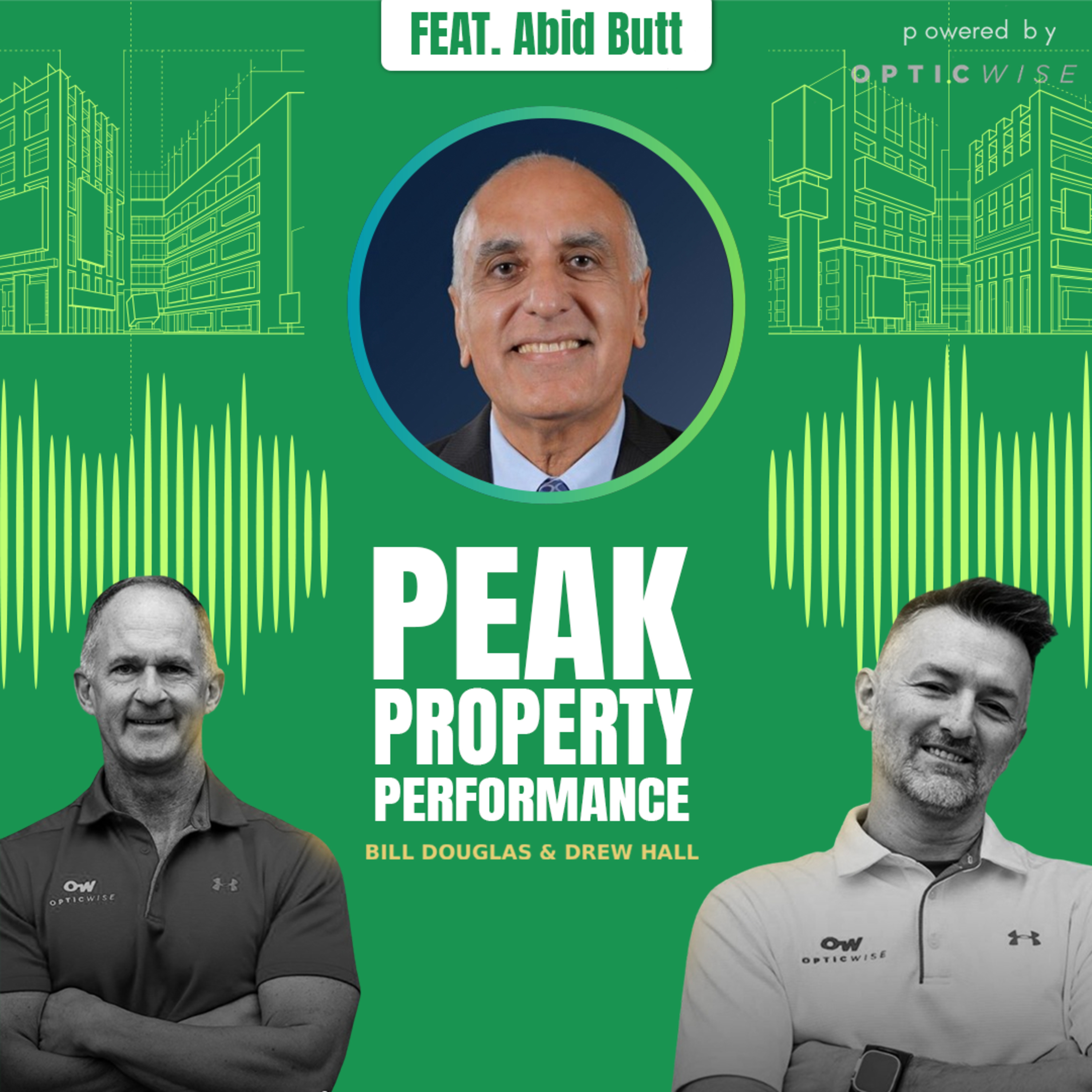
Asset managers sit in one of the most demanding seats in commercial real estate: protect performance, manage risk, allocate capital wisely, and decide which operational changes are actually worth making. In this episode, Bill Douglas and Drew Hall talk with Abid Butt — a hospitality and real estate executive who has managed a diversified portfolio worth roughly $9 billion across hotels, office towers, residential compounds, and a mega-regional mall — about what asset managers really need from data, technology, and CRE operations.
Abid explains why he treats assets as “living, breathing entities,” why risk-adjusted yield is the number that matters, and why so much technology spend fails to deliver. The throughline: connected, reliable data and predictive analytics beat backward-looking dashboards every time — but only when owners, operators, and technology teams align around a clearly defined objective.
“AI is not going to replace you, but somebody using AI will.”
— Bill Douglas
What you’ll learn
- What asset managers actually evaluate — risk-adjusted yield, NOI, and EBITDA margins
- Why asset managers, operators, owners, and vendors are more aligned than they appear
- Why predictive analytics beats backward-looking dashboards and report-card metrics
- The most common reasons technology deployments fail in CRE operations
- How to think about AI spend when there is no clear objective — and what to do instead
- What actually motivates owners to change before a problem becomes a crisis
Key moments
- 00:00Intro: Drew and Bill welcome guest Abid Butt
- 03:10What asset managers evaluate when judging property performance
- 05:38Are asset managers misunderstood by owners, operators, and vendors?
- 08:13The visibility asset managers wish they had: real-time, predictive data
- 10:13Forward-looking KPIs vs. backward-looking dashboards
- 13:04Why technology purchases fail without vision, training, and support
- 17:18Golf-course irrigation: a cautionary technology story
- 19:39“Oodles of money” spent on AI with no clear objective
- 24:07Why AI shifts skill sets instead of simply replacing people
- 25:46What finally motivates owners to make a change
- 29:51Extra Floor: rapid-fire with Abid Butt
Resources mentioned
- OpticWise: https://opticwise.com
- Peak Property Performance Book
- Peak Property Performance Podcast: https://www.peakpropertyperformance.com
- Apply to be a guest: https://www.peakpropertyperformance.com/be-on-the-show/
- Book a Digital Infrastructure Review: https://www.peakpropertyperformance.com/ppp-review/
Connect With The Guest
Abid Butt
Hospitality & Real Estate Executive · Asset Management
- LinkedIn: linkedin.com/in/abidbutt
- Email: me@abid-butt.com
Connect With The Hosts
Bill Douglas (Host)
- LinkedIn: linkedin.com/in/billdouglas
- Email: bill.douglas@opticwise.com
- OpticWise: opticwise.com
Drew Hall (Co-Host)
- LinkedIn: linkedin.com/in/drewhall33
- Email: drew.hall@opticwise.com
- OpticWise: opticwise.com
Read the full transcript
Why Asset Managers Focus on Risk-Adjusted Returns
Drew: Asset managers are responsible for balancing performance, risk, and capital allocation. What are you really evaluating when you look at a property?
Abid: Asset management is about optimizing and enhancing asset performance. It goes beyond just numbers because properties are living, breathing entities. Ultimately, we look at risk-adjusted yield, NOI, EBITDA margins, and whether the asset can meet long-term objectives and service debt.
The Gap Between Ownership, Operators, and Data
Drew: Are asset managers misunderstood by operators or vendors?
Abid: Sometimes. Asset managers are often seen as the people pointing out problems, but the reality is that everyone wants the same outcome: stronger returns and better-performing assets. Misalignment usually comes from poor communication and unclear goals.
Bill: Asset managers want better visibility and earlier warning signals, but systems rarely make that easy.
Abid: Exactly. Data is fragmented, and systems often don’t communicate well. What’s needed is predictive analytics that helps organizations look forward instead of relying only on historical reports.
Why Technology Deployments Fail
Drew: Buying technology isn’t the same as having a strategy. Why do so many deployments fail?
Abid: Organizations often buy technology without clearly defining the problem they’re solving. Users ask, “What’s in it for me?” If the system creates more work without improving productivity, adoption suffers. Successful implementation requires vision, training, accountability, and leadership support.
Abid: I’ve seen organizations spend heavily on systems like irrigation automation or building controls, only to struggle later because support, training, and maintenance were missing.
AI, Predictive Analytics, and Operational Change
Bill: The industry is spending heavily on AI, often without a clear objective.
Abid: There’s definitely fear of being left behind. AI can improve productivity and user experience, but it shouldn’t simply be viewed as a way to eliminate people. Technology should help teams become more effective.
Bill: Predictive analytics becomes more valuable when the underlying data is connected and reliable.
Abid: Exactly. The challenge is that commercial real estate still operates with siloed systems and disconnected workflows.
What Drives Owners to Finally Change
Bill: What finally motivates owners to adopt new technology or operational strategies?
Abid: Usually pressure. Sometimes organizations wait until they’re already struggling. But the real value of technology is preventing problems before they become crises. Change works best when organizations move thoughtfully, define objectives clearly, and stay adaptable.
Extra Floor — Rapid-Fire with Abid Butt
Drew: Best career advice you’ve received?
Abid: Always keep learning. Early in my career, I tried to learn my boss’s job—not to replace them, but to grow.
Bill: What habit makes you more effective?
Abid: Early morning workouts. They help me manage stress and stay focused.
Drew: Early bird or night owl?
Abid: Definitely an early bird, although hospitality taught me to work both ends of the clock.