Episode Overview
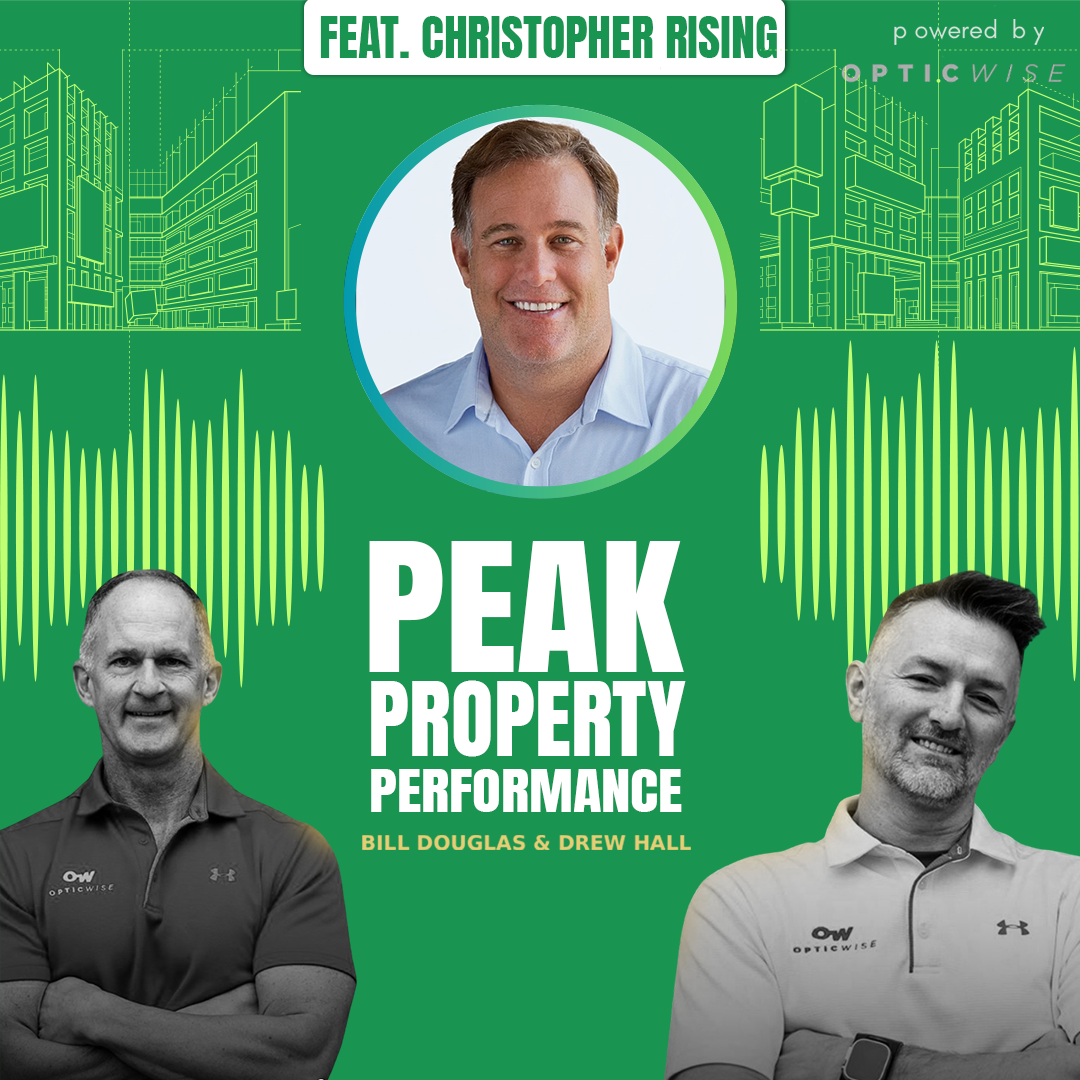
In this episode of Peak Property Performance, hosts Bill Douglas and Drew Hall welcome Christopher Rising, Co-Founder and CEO of Rising Realty Partners, to discuss why commercial real estate owners must take responsibility for their digital infrastructure, building systems, and data. From launching an internet service provider to exploring edge computing in vacant office buildings, Christopher shares how thinking like an owner creates opportunities to improve property performance.
“You know, we don't always, sometimes we need that, what that vendor is selling and we can't own the data the way we want to, but at least we're aware of what we're giving away compared to the old days.”
Christopher Rising
What you’ll learn
- Digital infrastructure and owner responsibility Internet connectivity and redundancy Building data ownership and monetization Vendor contracts and data rights AI and operational intelligence Edge computing and vacant office space Electrical capacity and property value The future of flexible office leasing Episode Highlights When Connectivity Becomes the Owner's Problem A prospective tenant nearly walked away from a lease because internet service couldn't be delivered on time. That experience led Christopher to co-found 5x5 Telecom, which expanded from one building to approximately 160 buildings across multiple states. Own More Than Bricks and Mortar Christopher explains that owners often overlook the value of their HVAC, security, connectivity, and other building systems. These assets generate valuable data that owners should understand, protect, and control. Connectivity Is a Competitive Advantage Bill and Christopher discuss why internet reliability, capacity, and redundancy are essential to the tenant experience. Owners must move beyond traditional vendor relationships and understand the connectivity their buildings provide. Building Data Has Real Value From access-control records to occupancy patterns, buildings generate valuable operational information. As AI increases demand for data, owners must be more intentional about who can access and use it. Protect Your Data in Vendor Contracts Christopher shares how Rising Realty Partners approaches vendor negotiations differently today. Understanding data rights, ownership, and access is critical, even when vendors hold greater negotiating leverage. What Happens When You Change Vendors? Owners can lose access to years of historical building data when switching providers. Christopher emphasizes protecting future data access and control before signing agreements. Could Vacant Offices Become Edge Data Centers? Christopher explores how underutilized office buildings could accommodate smaller data centers using existing electrical capacity. Rather than converting entire properties, owners may find opportunities in distributed computing infrastructure. Power Capacity Could Unlock Hidden Value Not every building is suitable for edge computing. Floor loading, backup power, available electrical capacity, and acquisition costs all matter. Bill encourages owners to understand how much power their buildings have and how much they're actually using. The Future of Commercial Real Estate Christopher predicts growing demand for flexible leases and move-in-ready office spaces. Connectivity, power, amenities, and digital infrastructure will become increasingly important to attracting and retaining tenants.
Resources mentioned
- https://www.peakpropertyperformance.com
- https://www.opticwise.com
- https://www.youtube.com/@PeakPropertyPerformance
Connect With The Guest
Christopher Rising
Co-founder and CEO, Rising Realty Partners
- Website: risingrp.com
- Email: ccr@risingrp.com
- LinkedIn: linkedin.com/in/christopherrising
Connect With The Hosts
Bill Douglas (Host)
- LinkedIn: linkedin.com/in/billdouglas
- Email: bill.douglas@opticwise.com
- OpticWise: opticwise.com
Drew Hall (Co-Host)
- LinkedIn: linkedin.com/in/drewhall33
- Email: drew.hall@opticwise.com
- OpticWise: opticwise.com
Read the full transcript
Drew Hall: Welcome back to the Peak Property Performance Podcast. I am your co-host, Drew Hall, and with me today obviously is Bill Douglas. Bill, welcome.
Bill Douglas: Hey, everybody. Glad to be back.
Drew Hall: Yeah. All right. So what is today's theme? It's a long one. It's a mouthful. It's important. Act like an owner. Take responsibility for the systems, data, and infrastructure that drive the assets. So real quickly, before Bill introduces our guest, let's do all the things, just the admin stuff here, right up top and real quick.
Drew Hall: So like, subscribe, share, ring the bell so you get notified of new episodes as they drop. We try to drop those really regularly. This is all how we're spreading the word on this Peak Property Performance movement. And again, this goal is to truly change the industry, not just talk about what we see, what we've observed, what we think could be done better, but to truly influence it. And we see that happening. We see that happening as we review through the history of episodes as they build. So if you think that you know someone who could be a guest here that would provide value, or if it's you that's listening right now, and they find that to be true for yourself, we welcome CRE thought leaders from all stages of ownership and operation. So just please reach out to us.
Drew Hall: And the easiest way to do that honestly is right there at peakpropertyperformance.com
Drew Hall: And you can always find us on LinkedIn as well. So, Bill, tell us about today.
Bill Douglas: Well, before I read his intro, today we're joined by Chris Rising. So, Chris, say hello and tell us where you're hailing from today.
Christopher Rising: Well, hello, everyone. I'm here sitting here in Pasadena, California, though we're based in Los Angeles right now. Right, right above the Rose Bowl in Pasadena.
Bill Douglas: Beautiful Pasadena. So you're going to be really busy in 2 years for the Olympics?
Christopher Rising: Yes, very much so. Yeah, we've got,
Bill Douglas: I already have my tickets.
Christopher Rising: Okay. We've got men's and women's semis and finals of the Olympics. For soccer here.
Drew Hall: Yes, it's amazing.
Bill Douglas: Well, Chris is the co-founder and CEO of Rising Realty Partners, a vertically integrated owner-operator, investor, and developer with more than 5 million square feet of commercial real estate under management across multiple US markets. That's quite a number, Chris. Chris has spent his career thinking like an owner, whether that means operating office, industrial, and data center assets, co-founding Five by Five Telecom after experiencing a connectivity problem firsthand, Or exploring entirely new uses for underutilized real estate. Today, we're going to talk about what it really means to take responsibility for the systems, data, and digital infrastructure that increasingly determine how the asset performs. So Chris, again, welcome to Peak Property Performance. Thanks for willing to take your time for this.
Christopher Rising: I'm really pleased to be able to do it, Bill. And I appreciate you reaching out to me after we met. And I'm excited to just give you my thoughts on real estate and how we operate it.
Bill Douglas: Good.
Drew Hall: Yeah, fantastic. All right, Chris, so you told a story this year at the CDIA, that's the Connected Digital Infrastructure Association for everyone. So at CDIA, you mentioned a story about a major tenant that moved into one of your buildings and we'll just say a very well-known ISP failed them. And your initial reaction was, well, that's not our job. But eventually that experience led you to co-found this entire telecom company. So talk about that journey. Like, What was it like going from that ain't our job to what you became and what you realized?
Christopher Rising: Well, I'll tell you what, it's almost exactly as you described it, but there's 2 pieces that I would add. One, we had built out a spec office suite, a very large one. I'd spent lots of money and we did not expect, it was downtown LA 2014, that it would lease so quickly. So what I'm looking at is this investment we had made, And someone really ready to sign a lease. And their question was, what do I do about internet service? You know, and you just kind of go, what do you mean? I spent my career as a broker and now I'm a principal. What do you mean I have to worry about this? And they literally said to us, if we can't get the internet done, I don't know if we can sign the lease. So we're on the phone doing as an owner what owners like to do. Like, we got to make this happen.
Christopher Rising: And we couldn't make it happen within the timeframe, but fortunately nobody else could have made it happen within the timeframe. So they still signed the lease, but I came back with our team and my dad was very involved in the business at the time in 2014. And we just said this, what do we do here? And I had mis-hired somebody. He was running our property management, wonderful detail-oriented guy. He wasn't a head of property management type of person, but you know what he was? He was a very, very shrewd entrepreneur who understood technology. And really, I first met him when we were doing this. He was helping us install our software systems. And I liked him so much, I made him head of property management.
Christopher Rising: I mean, at this time, our company was one building. Let's keep that in mind. And instead, he said to me, Chris, you know, I did a little research. It isn't that hard to start an ISP. And I said, well, first of all, what's What's an ISP again? Internet service provider. Oh, it isn't that hard. You know, what are you talking about? It must be really hard because the ones I see on TV are huge companies. He said, no, you know, thankfully in the United States, we have these laws that said if you put this fiber down the streets, that they got to be able to sell it to other people.
Christopher Rising: They can't just control it for themselves. And so
Christopher Rising: Mark Gittleman, who's one of my dear friends, said, I think we might have a business if we could do this because We got other tenants. We were just thinking about one building, by the way. That's how it all came together. It was my desperation of thinking, we're not gonna be able to sign this tenant because we can't do it. And then the multiple phone calls we made to a bunch of the big names that we all know who are out there. And it was right in that era of, you know, can you hear me now? Can you hear me now? On the cell side, on the cellular side. But people were using those same players to do the internet.
Christopher Rising: And to me, it was a whole realization that there were opportunities that we could impact our own single building. And then we started to understand as we bought more buildings, could we or could we not? It's not as easy as I had thought at the beginning because you can access those lines in the street, but they cost money. They can't say no, but you still got to get it from the street to your building and not everything lines up. Then you got to bring it in your building. And then I learned all about the riser business. I didn't know what the riser business was. And realized we had inherited a contract with a riser business who had like a 10-year deal on controlling the risers in the building. And nobody in our due diligence told me anything about we had a riser contract.
Christopher Rising: They didn't... I didn't know what that meant. So we had to learn that. We have not gone into the riser business. We quickly figured out it would be better to be friendly and work with the riser companies than it would be to try to compete with them. So we have some great relationships with the riser companies. companies. But we took 5x5 from one small building. And now I think last I checked, we're in 160 buildings, we're in multiple states.
Christopher Rising: But it's still, I mean, it's, it's a hand-to-hand combat business, because the big, the big boys and girls have a lot of advantages. And, you know, there's something to be said, no one ever got fired for hiring one of those big guys for their internet service if it went down. Yeah.
Drew Hall: And I mean, you know, just your description of the riser business, you know, even as cursory as it is so far, it In my mind, I'm just thinking like almost like a squatter's rights. You know, there's so much confusion so often around those contracts. Sometimes there's some loose language, sometimes there's misplaced contracts. And I think that even sometimes the confusion is what drives the... I don't want to say the competition, but the... gosh, what am I trying to say? Maybe the inability to compete sometimes. Like in your case, that's really impressive to stand up something new and take it on and obtain that level of service that you're looking for. That's a really big step.
Christopher Rising: Yes. Well, I've got to give a lot of credit to my, our CEO and the person who runs it, Mark Gittleman, who constantly is pushing what services we should do around this. And so 5x5 has grown into the managed service business. We... it's grown even more into other areas because you do realize that when you're that connection point, most companies are not sophisticated enough on their technology to have a CTO in place. If they have a third party, it's kind of rare. So he's been able to find ways to make that internet, but It's all driven by the internet contracts we sign. You know, 5x5 signs a 5-year deal. It's usually coterminous with the lease.
Christopher Rising: And then what else can we do to drive the revenue? I think also it's a tough business because it's such not a high priority for a company. They just assume they have it that you may not even know that there's an opportunity to get the business because somebody just goes and signs with the 3-letter company or the other company out there and all that. And you didn't even get a chance to pitch the business.
Bill Douglas: And they overpay just because they're used to it. They overpay for poor service. We see it all the time. We have a lot of office, let's say, properties in the portfolios we serve, and we see it all the time.
Drew Hall: Yeah. And wrapped up in all of this, there's so much of that just because it's always been this way methodology, as opposed to, wow, there really are ways to do this much, much better. But it takes a preemptive design and an overarching, you know, strategy, as opposed to just lots of things flying at me. Let's figure out how to make a decision on this one thing. It's not just building-based. It needs to be building-based, entire building-based, but also like you're alluding to there, Chris, portfolio-based as well, because it can scale. It can scale, but it does take some work.
Christopher Rising: I also think, I agree with you, it can scale, but I'm still amazed at the disconnect between the employee who's working and needing either the Wi-Fi in the space or just the direct connection at the highest possible speeds, and then the person who decides what internet service they're buying. And it's really, to me, sometimes amazing how they don't... you would think they'd all be on the same page and they're not. And someone makes a decision, either they're not getting enough capacity or there's no redundancy. The redundancy just blows me away is how few companies really understand redundancy. It's what drives me nuts about my home internet is I don't have redundancy because the cable company and they... I mean, unless I want to pay for 2 really expensive lines, there's no real redundancy. And, uh, but in business, as we all know, So that's fatal.
Drew Hall: Yes.
Bill Douglas: Well, it's, it never ceases to amaze me how many tenants move into a building that has redundant internet available and they either don't want it or they don't even want to look at it because they're going to do it their way anyway. And they go pay for 2 whole circuits when there's probably 3 in the building already and there's a failover system in place. Like it just blows my mind. Like, why would you pay more money to do it a way that's less reliable?
Christopher Rising: Yeah. I
Bill Douglas: don't quite get that.
Christopher Rising: I don't get it.
Bill Douglas: But the status quo bias is pretty strong in this industry.
Christopher Rising: Yes.
Drew Hall: So, Chris, that's... oh, go ahead, Chris. Yeah.
Christopher Rising: No, no, no. I was saying I agree.
Drew Hall: Yeah. Well, okay. So that's, that's internet services, which obviously is a... I always say it's, it's a very critical ingredient in the overall recipe for sure, for a building and for a portfolio for sure. Where else do you see owners making that mistake of that's just the vendor's problem
Bill Douglas: or the tenant's problem? Either one.
Christopher Rising: Well, I think that there is this curse amongst owners of real estate that they really only think they own the bricks and the pipes and the cement. And they just don't realize that when you spend millions of dollars on that HVAC system, millions of dollars on the emergency system, that you own it. They don't think about this. And what's happened now, I think because some of the larger landlords in the world, the Brookfields of the world, are much more sophisticated, that There's at least awareness. But look, we all know that across this country, there's office buildings and commercial buildings that aren't owned by the big players. So it's just mom and pop, or it's just the small operator. And they don't realize that they have something of tremendous value. And that's the data that is produced from all of these systems.
Christopher Rising: And they literally let it walk away every day. They just let somebody else monetize it. And in the world of AI, data has value. And I mean, I've had people come to me thinking I'm so naive that I should pay them for my own data.
Bill Douglas: I could probably name that vendor.
Christopher Rising: Yes. And it's like, what do you mean I'm going to pay you so then you can come back with my data and tell me what I'm supposed to be doing? No, no, no. You should be... because you're going to use this data like all the LLMs now do, right? And they're going to build on it. And somehow I'm paying you for that luxury? Not a chance. But it happens. Every day. And, you know, I think it'll bleed down eventually into everyone's own home where they're not going to let the big HVAC system makers or the big alarm companies or all of that just have their data. But in a building, especially an office building, but even an industrial building, that's, that's your widget and you shouldn't give that away.
Drew Hall: Yeah. Well, real quickly, because we're about to transition to talk more about data specifically, real quickly though, before we leave this, this concept of maybe more of an infrastructure or digital infrastructure perspective, can you picture a moment or an experience where you ultimately decided like, now we're never going to let this happen to one of our tenants again? I mean, maybe it's in and through one of these examples you've already given, but that concept of, oh, never again in terms of a tenant's terrible experience.
Christopher Rising: I feel like you're leading towards something. I'm like that kid taking a test that I don't, I don't think I have the right answer, but I'm going to come up with something. Well, I
Bill Douglas: mean, your answer is the right answer, Chris. There's no wrong answer.
Christopher Rising: No, maybe this is something you wouldn't naturally think of, but I think about it a lot now because there's this debate about the purpose of office and how office is used. But one of the things that we track, especially in the larger office buildings, is ingress and egress of our tenants through their swipes of their key cards. That's a very valuable thing. And there is a company out there I won't name that has made a whole, especially during COVID a whole reputation of saying this is the building occupancy and the blah, blah, blah, blah, blah. And I keep going, why would we let some other company tell people what our occupancy is.
Drew Hall: Absolutely.
Christopher Rising: And it goes down to even... not that we get into our tenant suites and know if someone's sitting in their seat. I mean, there are things you can do around that. But we do know, like, if someone not only gets in the elevator, but we know if someone swipes into their office space and at what time and all of that. And I don't think most owners think that has any value. And I would say in a world where data is so valuable and all these AIs out there trying to figure out human nature and human interaction, when people actually use an office space is something of great value. And I don't think anybody monetizes that or tries to monetize it.
Bill Douglas: Well, Chris, you talked about one way of collecting that usage data, and that's the swipes, right? Access controls. But we have seen that's one silo of data, maybe that your vendor's not charging for, maybe you can actually get it. But there's other ways to get it too. The wireless system, Wi-Fi or In-building wireless, you can do it through lighting controls. I mean, you can even, some thermostats will take it too. And it's not personally identified information. It's just bodies, right? So all the data we ever talk about is anonymized. We don't, we don't do anything with personal information anywhere in our whole life.
Bill Douglas: We don't. But how did you get from having separate pieces of information to actually connecting them and using them to further the tenant experience and therefore your NOI at the property? Talk about that evolution in your own company.
Christopher Rising: Yeah, I'll give credit to the big owners of real estate, the Brookfields of the world out there, because they've had the financial wherewithal to really invest in some of these DAS systems and then taking the information from it. So it's not just as simple as whether the lights turn on and off, something like that, but knowing whether someone's using a cellular phone in their space. And then, and that's more to just how do they provide services to it? And we haven't, in a lot of our properties, we just don't have the reserves there to build out some of that. But I have seen it. I mean, you go to, if anybody gets the chance to go see JP Morgan's new building and the way they collect information in that building is insane and Goldman Sachs as well. And so you're seeing people who have much bigger pockets be able to create an experience in an office building based on where people are moving. And a lot of that is the Most often now, what I'm finding, it's through the cell phone pings. But, you know, we're able to... what we're able to do with 5x5 is I can then go to the cell companies and say, look, we have these repeaters and we have these cell duplicators.
Christopher Rising: And because we do it to help our internal tenants, and I know everybody who's driving down the street and I know they're connected to the internet. I know because it pings to us. And we had a... we thought we had this range, this unbelievable business because early on, Google was paying us for that information. And then they quickly realized they didn't need to pay us. And then, uh, and they changed the whole model. But early on we thought, oh my God, this could be a billion-dollar business based on 2 months. And then they quickly backed down. And because Google was trying to figure out, I personally think whether they should be in the cell business or not, but I don't know that.
Christopher Rising: And this was years ago.
Bill Douglas: We had the same experience. Yeah. And we can collect the same information. So we're, I don't know that the audience knows that that exists. So it's nice to hear you bring it up and not us. We're not pitching anything. It's nice to hear you share that story.
Christopher Rising: Well, I'll just tell, I, I met, so anybody who's ever thinking about maybe doing a crime, you better not have a cell phone with you because that cell phone tells the whole story of where you are. And I don't think we ever think about it, but if you really want to know where someone is, you, it's not just Apple's Find My Phone kind of thing, find my iPhone. And, and that's information that as Because what we have really moved into with our business is if we can't get an access agreement to a building, we can still use antennas from a building that is wired and we do have the infrastructure. We can go, we have direct line of sight. We could send internet if somebody, if we could sell the service next door. And because those antennas exist, it's collecting information. They're collecting information from everywhere.
Bill Douglas: Yeah. I'm very familiar with all of that. Again, I'm glad to hear you say it. So do you, relative to the operation of your properties, And the stories we were telling here, does the underlying technology matter to you? Are you ultimately only interested in the outcome and the user experience and therefore the NOI?
Christopher Rising: It matters in the sense of cost and it matters in the sense of reliability. Brand name doesn't matter much and it changes so quickly. It's hard to fall in love with any one provider. I mean, I don't want to, I guess I shouldn't use names here, but there are a couple brands. that from the antenna side and from the infrastructure side and all of that, that we rely on. But I don't get that. Now we're getting out of my swim lane.
Bill Douglas: I say that's above my pay grade. Yeah, that's what I like to say. It would be in Drew's lane instead of my lane. So you've talked about a couple of use cases. What other ones do you see beginning to emerge? Not because of AI, but because of the availability of data.
Christopher Rising: On data itself. How
Bill Douglas: has it changed the use cases or changed how you're hiring in your company or changed your, you know, the rocks for this Well, I
Christopher Rising: will say it's such an ever-changing field. I do feel like you're not excluding people by age or experience anymore. You're not excluding people by age. You're excluding people where they have the experience in knowing what to do with this data. So what I find interesting is you're seeing people that we interact with from all ages, from very young out of college to people who've been in the industry 30 years who can add value to what we do with this. Trying to think if there's a specific business that exists today because of this, then it didn't. I mean, there's a ton of consultants out there that I think are selling this kind of services. I don't know if that's what you're getting at.
Christopher Rising: I mean, I, I have some other,
Bill Douglas: I meant relative to your business, has it changed your operations because of the availability of data?
Christopher Rising: Absolutely. Um, because we know it's valuable and not everybody knew it was valuable and we now put it into contracts and we don't just sign something that a big vendor gives us like we used to. I mean, we used to just kind of sign things got put in front of us. We're trying to get the grander mission done. So we'd sign it. No, no, no, not anymore. Now we fight and we lose sometimes. You know, we don't always, sometimes we need that, what that vendor is selling and we can't own the data the way we want to, but at least we're aware of what we're giving away compared to the old days.
Bill Douglas: We did a recording very recently. It's not even out yet, but it was a It is with a very high-end, uh, data commercial real estate attorney out of Chicago. And he talks about how the standard is just sign it. And most people don't even know that they're giving their data to the vendor and it's theirs for life. And they're, it's actually their data. They just have a license to use it if and when they want to, only inside of that vendor system. And he flipped the paradigm entirely and said, whoa, you got to rethink this and sit down with your contract. So I think you're ahead of A lot of the market by having that viewpoint, Chris.
Christopher Rising: I mean, it's nice to hear. I think there is a reality about leverage. You know, we've been told several times, no, you just sign this if you want this, whatever, call it HVAC, call it whatever. And sometimes you do, you just decide that it's not, but, but no, I mean, most people, at least it's, it's a topic that's much more aware. And I, I think it's because of these big LLM AI who people, it's now made it on the Wall Street Journal. that people are taking data and data has value. So I think it's leveled it up a little bit for us where we didn't have that playing field before. But, you know, it's just, you didn't think to ask the questions and now people are thinking to ask the questions.
Drew Hall: Well, so Chris, you mentioned, you know, the real case study of Google and data. What about, you alluded to some at CDIA, you alluded to some other startups calling you and asking for your data and realizing like, no, Nope, not doing it. So how would you... yeah, go ahead. How would you describe that? Why protective? Why be protective of it?
Christopher Rising: So one of the examples I gave is, you know, right now, if you have any connection to the startup world, and we've had because of 5x5 and a few others, some connection, we get lots of calls, lots of people saying, hey, can we test with you? Can we do that? And now since LLMs have become so big, what I see happening is Anthropic, And OpenAI, mainly those 2, are getting young entrepreneurs to start companies that will have specialization. And so one area of specialization is all the data about coming in and out of an office building. And I've gotten pitched several times to like, oh, we'll pay you for it, we'll pay you for it. But then we get into it and all of a sudden it's switching to I'm paying them or it's neutral, but then they get, because They have to use it. And ultimately their end customer is OpenAI or Anthropic. So you start to read these documents and you're like, this isn't some 22-year-old out of MIT doing this. This is some big company who really understands what they're doing. And it's happened at least twice.
Christopher Rising: So it's more than just a random exercise. And I think OpenAI and Anthropic, they're so concerned about being, about gobbling up the world and the data of the world in a lot of ways that they're finding ways to get it where they're not the big bad wolf. And, um, we just said no. Uh, the one I talked about at that conference was because they totally bait and switched us. You know, it went from, we'll pay you 10 grand a month or something for this data here to we were paying them. And, um, I was offended and unhappy about it. And
Drew Hall: I
Bill Douglas: remember you saying, no, no, no. Like, yeah, no, hands up.
Christopher Rising: No.
Bill Douglas: On stage.
Christopher Rising: Yes, it was. But it was, but I, as the more I thought about it, It's because I think their end customer is forcing them to somehow make deals where they're a little bit more profitable. I don't know. There's something that was a disconnect and it jumped out at me and my reaction was no, no, no, not going to happen. You know?
Drew Hall: Which, I mean, if nothing else, I mean, at a baseline, that is an incredible, incredibly powerful place to start. Like, just like you mentioned, realizing that there is great power in that data and then also realizing that the data is even there. to, you know, open the gates to or close the gates to is a head start above and beyond many still operating in CRE today. So it's a good place to start.
Christopher Rising: Well, I think most people in Drew... Sorry, Drew, I'm interrupting, but I do think you have to have an ability to speak in ones and zeros to understand that data is relevant. And most people in commercial real estate, they're not thinking in... they're thinking in IRR, you know, they're thinking on cash-on-cash return. They're not thinking about it as data that are really at all comes down to 0 and 1, 0 and 1, 0 and 1. And that creates actual information that does have value. And nobody probably should. I mean, you go get your MBA in real estate school, they're not going to talk about this kind of stuff. So I think it's important. And that's what you guys are doing, a great service to people by just getting this out there.
Christopher Rising: It does matter when you own 3 office buildings in St. Louis or, you know, 2 office buildings in some other city, because you start to have that little scale and You want to take every penny, you want to control it at least. Maybe you don't get to earn a return on it, but you want to control it.
Drew Hall: Yeah.
Bill Douglas: Protect it.
Christopher Rising: Yeah. Protect is probably a better word.
Drew Hall: Yeah. And lots of talk around various compliances, you know, for... I mean, all tenants should be thinking about it, but many of them don't specifically need compliance certifications. But many of the commercial tenants that are in these buildings under our care definitely do. And there's active engagement in making sure that those compliances can be met in these multi-tenant spaces. So data, data, data. And, you know, kind of to build on that idea, I mentioned it like a gate, right? There's a gate that you realize there is the ability to open or close or filter kind of thing. Think about that for a second. Like the difference between allowing a vendor to use your data to provide a service versus giving a vendor control, just unadulterated control over the data.
Drew Hall: There's a lot of power there.
Christopher Rising: Yes, there is. I think unfortunately, One thing in real estate is I didn't realize until I really got into the business is when you buy something, you inherit a lot of contracts and you inherit it. So somebody has already... and it's hard to reverse that baseline when the contract comes back up. It's very hard. And because they'll give you a better rate or they'll give you it, but they're going to still control the data. I don't want to give the impression to the audience that we always win these arguments or these discussions. They're not necessarily, you know, gladiator battles, but they're discussions. And sometimes it's just Sorry, I have more leverage than you have.
Christopher Rising: So I think you just try to have your pointed in a direction you want to get to. And sometimes you get there and sometimes you, on that one contract, you're not going to control it.
Drew Hall: Well, and I was thinking too that it might mean just redlining something that you otherwise wouldn't redline. You might've just signed, but go for it. Go for the redline.
Christopher Rising: The great thing about Claude and OpenAI and all this stuff is there is a resource now. You can't just throw You could tell it, this is what I'm concerned about and throw it through there. So I gotta tell you, it's driving me nuts on how smart everybody thinks they are with Claude when we send out our contracts.
Drew Hall: Yeah. Yeah. That's my favorite when you ask a question that deserves about a 10-word answer and you get 10,000. Exactly. Exactly. So, I mean, you kind of alluded to it. It was almost like you were reading my script here. What happens to the data when the owner changes vendors? And like, how should, how should owners be thinking about that?
Christopher Rising: Wow. That's a... my initial thought was, how much did I leave behind when we switched so we could start controlling going forward? Because I don't know if we thought a whole lot about looking back. I think the win is you, is you start to have, you protect your data and you have some control over it going forwards and you, you just live to fight another day, I guess, because you can't really get it back if your old contract didn't give you control of it before. I think, I know we always ask. You know, where is this information for the last 10 years? And it's usually for us, just to be clear, it comes down to our building operating systems, our HVAC systems, our security systems. So, you know, since we've gotten proactive about this, I don't have as many legacy. And in the industrial world that we're spending much more time, this is all new ground for everybody. I mean, so I don't even think most of the vendors, some of the industrial projects we're now buying, there is no legacy.
Christopher Rising: We control data because the contracts don't have that in them. Neither for the vendor or ourselves.
Bill Douglas: Well, let's make another shift then. And, and this one's near and dear to my heart because for many reasons, but I heard you make a provocative prediction recently. And part of the answers for severely underutilized office buildings may not be residential conversion at all. It may be edge computing. So walk us through that thesis. I completely, uh, I'm into this. I've been studying, I've been watching it. I said something like this a year and a half ago and people called me nuts.
Bill Douglas: And then I heard you say it. I'm like, wow, me and Chris have the same thought here, but I want to... I want you to elaborate on it, not me.
Christopher Rising: Okay. Well, I appreciate it. So to me, this goes back to when I had a very brief career as a real estate lawyer, as a leasing lawyer. And I remember one of the things I tell everybody, I stopped practicing because I just wasn't any good. So practice wasn't helping me with the law. But one of the things that I remember so distinctly was we did a couple of big law firm deals. Class A high-rise office buildings. And one of the areas I had to focus on was load per square foot on the flooring.
Christopher Rising: And that was because people had law libraries that were very heavy back then. These were literal library things. So you had to negotiate what the floor slab stability was. And then you also had to, because they had these big, it was called word processing back then, but it was basically a whole floor of copying machines and people taking dictation. And, you know, this is before everybody had Microsoft Office on there on a computer. When I first started in the business, you didn't have a... you really have a computer on your desk in the early '90s. But I thought about those 2 things, and I remember that part of it was power because those copying machines needed power. So you were always negotiating, you know, watts per square foot.
Christopher Rising: And then I figured, you know, you kind of back into it and you go, why is that? Well, when the developer gets their CUP, they've made a deal with the power company that the building gets so many watts. And so those are in... that's in the development agreement. The building gets that. And you start to look today and you're going, geez, these buildings are 50% leased. That means they're using 50% of the overall allocation that building has or less. Yes. And so what I believe is going to happen is owners of properties, both industrial and office, but probably office in the urban core, are going to get much smarter about this and realize they have something of value. The power cannot be taken away by the city.
Christopher Rising: They have a contract, they have their CUP. They're going to start figuring out ways to sell that power. And that obvious buyer is a data center. Well, big data centers would gobble too much of it. But if we can create these edge... call it edge, call it whatever you want to call it. But the idea, the idea is that you put 10 racks in there with servers and you use the unused power and they pay you for it directly. You submeter it and you pay for it directly. I think that's a way to combat this anti-data center feeling that's out there because that power is already spoken for, for that project.
Christopher Rising: It's just not being used. Now, people get upset, I guess, but it would be used if it was full of people in an office building. And now half of its people, half of its racks of servers. I personally think that's a real option to combat because latency is real. So it really is. You can build these big things out in Vegas. You can build these big things out in parts of Texas that aren't developed. But latency matters.
Christopher Rising: And I feel like people, you know, they really do care if they're on that Amazon webpage and it doesn't load, they just kind of go on to something else. So if you can start putting these in our, in our CBDs, our central business districts, and you can do them and the company puts together their data center by doing it in 2,000 square feet on the 3rd floor and 10,000 square feet on the 4th floor and, and just staying within the allocation that they have, I think that's a business that I hear it's coming. I've been approached. We're doing a few discussions, but I think that's a real business.
Bill Douglas: Well, the software to put them together has come a long way. And Drew's an expert on latency. So if we needed to chime in on that, we could ask him, but you, the ability to put 1,000 of these together to get your gigawatt is now doable in a CBD or a group of CBDs where it wasn't just 3 to 5 years ago. So back to the building conversation though, what makes one building a candidate for this and another completely unsuitable? Is it purely the power allotment or is there other things that we should be looking at?
Christopher Rising: Well, until we get to servers being more lightweight, floor load is a big issue. So we've owned that, we own data centers and we've owned office buildings that have been converted to data centers. And floor load is often misinterpreted. People don't realize it. And it's a real thing. You can't overload a floor. And there are horrible examples of that. I think the other issue is redundancy of power.
Christopher Rising: UPS systems work for a bit, but still at the end of the day, to be reliable, they're going to want a diesel generator. They're heavy.
Bill Douglas: They're very heavy too.
Christopher Rising: They're heavy. Yeah. And, and they're dirty. So diesel generator backup power is an issue. That's why I'm wondering if maybe industrial, especially the multi-tenant line industrial, the shallow bay stuff, maybe where they're one story. So you don't have that load issue and they're a little dirtier real estate. So you could have the diesel. So I think those are practical.
Christopher Rising: And I also think, you know, probably one of the greatest cartels in the country are power companies. I don't know if people really understand power and water companies. You know, they don't play by the same rules of government that everybody else has to play by.
Bill Douglas: So I spent the first 10 years of my career at a power company in the power industry. So I fully understand it. And I concur. I do. So how much vacancy or unused capacity does it take before the economics become interesting to a CRE owner?
Christopher Rising: I'm sorry, I missed that.
Bill Douglas: What's... how much vacancy and unused capacity Does it take for it to be interesting for you?
Christopher Rising: I think there's a third. What's the basis in the property?
Bill Douglas: Okay.
Christopher Rising: So if your basis is too high, you're probably not... that ownership group isn't the right group to do it because it's going to have a capital outlay. So this is going to be on somebody giving the keys back, the lender has to sell it, they sell at a bear market price. And all of a sudden you're down low and you say, okay, now do I invest in $200 a square foot for new WeWork-looking space? Or do I take that $200 a square foot and put that into infrastructure, which could mean making sure the floor loads are appropriate, making sure that you have the redundancy power? Seems to me like a no-brainer because you've just created more value just by doing those things. Because even if you don't get the data center user, I don't know how this is... how we live in a world where more power isn't valuable. So no matter what we do,
Bill Douglas: so at least ask the question so you know what you don't know. We talk about that a lot relative to digital infrastructure, but do you know what the power allotment is for your building and how much of it is being used is a great question. I don't know if anybody's ever brought that up.
Christopher Rising: Yeah. Well, you should. On so many shows, we've gone so far. That's important. If you're not doing that when you buy a building, then you're making a mistake.
Bill Douglas: I
Christopher Rising: mean,
Bill Douglas: you, I mean, when you're just operating it, like right now, do you know?
Christopher Rising: Yeah, we know very well. And in our office buildings, how much power is being used versus how much is allocated. Yeah.
Bill Douglas: Well, that's a great thing for our audience to take. Thank you for sharing. From an LP perspective, right? How does the investment case pencil compared with selling, continuing to operate it, or pursuing other adaptive reuse cases?
Christopher Rising: I don't think we know yet. I haven't seen that. I mean, maybe I'm wrong, but I mean, I've seen it done in downtown LA for the last 30 years because we had the famous One Wilshire, which was a converted office building to a data center. So I've I've seen it done, and I think we have a pretty good idea, but that's converting the whole building. I have not seen it. I would tell you that I owned a building with Oscar de la Hoya that was an office building that we bought right after the telecom bust where they were going to convert it to a data center. So they took out an elevator so they'd have riser space. And Telehouse, a Japanese company, put in one floor of racks with a big diesel generator.
Christopher Rising: They're still there. I think they're finally moving out after 25, 30 years. But we couldn't do anymore because it sucked up all the power. So, but that we actually bought that building. I don't even know when the deal was done originally, but the rest of the building, we got it up to 95% leased with office people. And we're always like, well, I wonder if we could bring in another floor because telehouse, you know, they pay all the time and all that. But we couldn't do it because it sucked all the, all the power had been sucked out of the contract we have with the LADWP.
Bill Douglas: The allocation was gone, huh?
Christopher Rising: Yeah. Yeah. So I mean, I bet you there's a lot of smart people right now looking in downtown LA at this exact same thing.
Bill Douglas: Well, I thought it was worth asking. Yeah. So, Chris, I'm going to ask you to look a little forward now, right? You've been a lawyer. I didn't know lawyer. I just added that, right? Broker, developer, investor, and operator in commercial real estate, right? That's quite a career. When you look at the next 10 years, what's something owners call technology today that you think we're eventually just going to call real estate?
Christopher Rising: Well, I think we're moving towards a world in office where I think Adam Neumann is right. Even though I hate to give him any credit for anything, the guy who founded WeWork, that we are moving into this kind of hoteling of office space. And that's the future. Only the biggest companies in the world will have buildings that they have all the floors in it, or only the biggest companies will take, you know, half of a building. But most companies are going to look at that line on their P&L of rent and say, I need flexibility. I can't sign 5, 10, 15-year leases. The workforce changes too quickly. I need a 3-year lease or a 1-year lease.
Christopher Rising: And I think that's just going to become standardized. And because of that, in order to attract that person for that 1 or 3-year lease, 5-year lease at most, you're going to have to have unbelievable amounts of amenities. And one of those amenities is power, and that's going to be really important. I think the data that comes out of these buildings are going to be really important. Because trying to lower your operating costs is the number one thing an owner of a building is going to do. And that means you got to, you have to know every piece of data that spits out of your building in order to lower those operating costs. Because the, and then I think that the value through AI and software is real, but it's only real if you can get to it. You can only get to it if you have the infrastructure in place to produce it.
Christopher Rising: Perfect. So I just think you're going to see people have big cap budgets when they buy buildings today. They're going to invest in as much power as possible, much riser space as possible, as much of the digital infrastructure as possible, the internet access, the redundancy, because people are going to sign a 1-year lease. And if you didn't meet their needs after 1 year, they're going to go to the next person who's going to do it.
Bill Douglas: And the connectivity tenant experience is going to be paramount to that too. So the tenants that we see doing this, moving in and out as much, they want all of that to just be included in the experience. They want to move in and not have to build out anything IT.
Christopher Rising: Yeah. Well, I left out one thing because we're seeing it in our shallow bay and industrial stuff is the importance of internet access is huge. And for 5x5, it's been a real... for us to get into that business, it's much harder because there isn't pipes going down the middle of every street all the time for these small bay projects. So you wonder, and I shouldn't name names, but you wonder whether Blue Origin and Starlink and all of that are going to have a real life because they do it via satellite and all a sudden it'll be as an owner, well, gotta have redundancy. So there's my satellite for Blue Origin, here's my one for Starlink and whatever competitors. But all of these that used to be just kind of manufacturing industrial buildings, now the businesses rely on internet connectivity. And if you can't get it through the street, you're gonna have to get it through the sky. And, and I think that's going to be a major issue, a major issue.
Christopher Rising: And, and how they price it, because I don't know if anybody knows, I mean, the difference between your residential Starlink and your commercial Starlink is thousands of dollars. That's the way they're pricing it right now. So it's almost not feasible for a business of 3,000 square feet in an industrial building to get a Starlink or a, I don't know, I don't want to name names too much, but they're the only provider really out there for this. And it's, something's got to give a little bit because it's not financially viable for most small companies in an industrial building to go get the internet. It's the volume. Yeah,
Bill Douglas: it's a volume limiter play.
Drew Hall: Absolutely. And you,
Bill Douglas: they don't want that volume right now, but they will, they'll be able to handle it in the future.
Drew Hall: And you can count on that technology maturing and changing. 'Cause I mean, honestly, you rewind the clock even just 10 years and think about, you know, data rates, uh, dollar rates, not, not speed rates, but the cost of doing data over even like a 3G, 4G kind of backup, right? It was cost prohibitive to put any data on there as a backup. And that hasn't changed a whole lot, but it's changed a little bit. So I think something like what you're mentioning in terms of the low Earth satellite Low Earth orbit satellite is going to change a lot more in magnitude in a lot quicker, shorter timeframe, just because of the technology and the investment and quite frankly, the intelligence of the people who are working on it. I think it's going to be a pretty big game changer.
Christopher Rising: Yeah.
Drew Hall: We've got some tenants out there asking for that in some of these commercial spaces as well. Okay. So Chris, a final shift here. Everything we've talked about up to this point is industry-based and, you know, uh, what we've learned, what we've seen, what we've done, what we've seen develop or develop ourselves. So now we do this final shift where we call it the extra floor, just in the spirit of commercial real estate. But it's really just a chance to let our listeners hear something about some things about you personally to get to know you a little bit better. So it's just 3 quick questions. Obviously no right or wrong answers.
Drew Hall: Just what's the first gut-level answer that comes to your mind? So number one, what do you think, what would you say is a good piece of career or life advice that you have received?
Christopher Rising: Yeah, I think the best advice I've ever gotten, and I didn't appreciate it when I was younger, was you can't do it on the moves. You have to be detail-oriented and you have to work really hard if you want to be successful. I think there's this whole culture out there through TikTok and through Instagram that if I'm just really cool and I just talk my way through it, I can do, I can be successful. And I hate to break it to everybody, but you know, you can define success however you want to define it. But I would say that the best teacher at a high school, the best coach out there, the best business person, the best priest, they are detail-oriented and they work hard. Yeah.
Drew Hall: Yes.
Christopher Rising: There's just no way around it. You can't do it on the moves.
Bill Douglas: Love it. So what is one habit or practice that consistently makes you more effective?
Christopher Rising: Well, this, I'm a big follower of Dan Sullivan and the Strategic Coach, and I've been doing it for 20 or 30 years. And there is nothing more valuable to either my personal life, my family, or my business than the half hour I spend almost, I mean, Every Sunday, if I somehow miss the Sunday, it's the first thing on Monday. Organizing my week, deciding what the three most important things I need to get done, and just here it's a practice in my life, and it's made so much difference. And now I use Claude and AI, and I do it together, and it doesn't take as long as it used to take. But I just spend about a half hour getting ready so I can go out the week. You know, I just I so I just not someone who wakes up and says see. what's going to come today. It just doesn't work for me.
Christopher Rising: So that half hour, the Sunday check-in, I call it, it's on my calendar at 3:30 every Sunday. And if we have some conflict, I move it around. And that's made professionally, but also in my personal life. You know, I've got athletes who are kids who are athletes and they've got busy schedules and I don't want to miss things. And if I'm not planning my week, I'll miss it.
Drew Hall: Yes. Yes. All right, Chris, last one. Are you an early bird or a night owl? And has that changed?
Christopher Rising: Uh, I'm an early bird. I, my father was an early bird. I I'm a former college football player and we worked out at 6 in the morning. I married someone who's less of that and it causes it. We've been happily married for 25 years, 24 years, but my eyes pop open between 5 and 5:30.
Bill Douglas: Love it. So we will put this on the episode page for this show, but Chris, how can listeners contact you should they want to reach out?
Christopher Rising: I appreciate that. I mean, I have a Substack, Christopher Rising, that they can go to on Substack. I've got Instagram @ChrisRising. I've got an X @ChrisRising. I'm still angry with myself. I had a webpage that was @ChrisRising and I missed the date on that. So I went to Christopher Rising on that website. But yeah, you know, and I've had a lot of interactions on LinkedIn and other places and I enjoy it.
Christopher Rising: I love the interaction. I like when People comment. I regularly blog. I try to blog once a week. Lately, it's been a little bit more about the issues and problems facing Los Angeles because we were the second largest landlord in downtown LA, and it's been heartbreaking to see the destruction of value and lives over the last ten years. So writing on that, but I try to write about real estate in general, and you know everything from interest rates to our views on acquisitions and. what's happening in that part of the world.
Bill Douglas: Well, Chris, I sincerely thank you. This has been a pleasure. It's been quite educational. Love the stories. Thank you for the time.
Drew Hall: Absolutely.
Bill Douglas: But for, you know, for the transparency, for sharing.
Christopher Rising: I appreciate it. I appreciate both of you. You know, I'm a big fan of people taking it upon themselves to get this kind of information out there. So I applaud you both for doing this and, you know, hopefully it inspires someone else.
Bill Douglas: Well, that's the goal. And thank you to all the listeners. You know, as Drew said at the beginning of the show, Like, follow, subscribe, and even more importantly, share it with a colleague, share it with a friend. Say, you should listen to this guy. Chris was awesome. And you know, and if you know somebody that should be on the show, tell 'em to put their hand up and be on the show. We want people to come on and share their stories. Like this just elevates the whole industry.
Bill Douglas: Rising tide raises all boats. We say a lot.
Christopher Rising: No pun intended.
Bill Douglas: So again, we'll see you on the... thank you everybody. We'll see you on the next episode of Peak Property Performance.